
The 3 AM Panic: Choosing Between a Broken Car and a Credit Card Bill
You are looking at a $1,200 car repair bill in one hand and a maxed-out credit card statement in the other. Your stomach drops. I have been in that exact spot, sweating over which bill to pay while my bank account sat at a big, fat zero. The truth is, paying off debt while being completely broke is a dangerous game. But I found a simple way out of this mess without losing my mind, and I want to show you how to do it too.
Have you ever found yourself staring at the bedroom ceiling in the middle of the night, feeling an uncomfortable tightness in your chest? This is exactly what happens when your car breaks down, your child gets sick, or your roof starts leaking, and your bank account is practically empty. You know you have a massive credit card payment due next week, and now life has thrown another expensive curveball directly at your face.
This is the harsh reality for millions of hardworking people today. You are doing your absolute best to be responsible by throwing every extra dollar you earn at your existing loans. You want that heavy burden of debt gone forever. But because you are using all your cash to pay lenders, you have absolutely zero safety net left for yourself.
So, what happens when an unexpected emergency strikes? You are forced to swipe that very same credit card you just worked so hard to pay down.
Many financial gurus will loudly tell you to completely eliminate your debt before saving a single penny. But let us be deeply honest with each other right now. That advice simply does not work in the real world where sudden accidents happen every single day.
You need a better, more realistic approach. You need a system that protects your sanity today while building your wealth for tomorrow. Let us break down exactly how you can protect yourself.

My 4-Step Blueprint in a Nutshell:
- Stop the bleeding: Do not throw all your cash at debt if you have zero savings. You need a shield first.
- The Starter Net: Build a quick $1,000 cash buffer to stop putting new emergencies on credit cards.
- The 70/30 Split: Use 70% of your extra money to kill high-interest debt, and 30% to grow your savings at the exact same time.
- Hide it away: Keep your emergency money at a totally different bank so you do not accidentally spend it on pizza.
The "Leaky Boat" Concept: Why You Cannot Afford to Wait
Imagine you are floating in the middle of a deep lake in a small wooden boat. Suddenly, you notice the boat has a hole, and water is slowly pouring in. This water represents your existing debt.
Naturally, your first instinct is to grab a bucket and start throwing the water back out as fast as you can. This action represents making your monthly loan payments.
But what if a sudden rainstorm hits while you are bailing out the water? If you do not have an umbrella or a tarp to cover the boat, the rain will fill up the boat much faster than you can empty it. That protective umbrella is your emergency fund.
Myth vs. Reality in Personal Finance
Let us clear up some of the most common misunderstandings about managing your money. Too many people get stuck because they follow outdated rules.
The Myth: You are losing money if you keep cash in a savings account while paying interest on a loan. Mathematically, it makes sense to pay off the highest interest rate first and save later.
The Reality: Personal finance is only 20% math and 80% human psychology. If an emergency happens and you have no cash, you will take on new debt at an even higher interest rate or face late fees. Having cash on hand stops the bleeding and gives you the emotional strength to keep fighting your debt.
Quick Action Guide: Should I Save or Pay Debt Today?
Here is my personal rule of thumb for deciding where your money goes right now:
Phase 1: Establishing Your "Starter" Safety Net
Before we even talk about complex budgeting or attacking your high-interest loans, we need to create a basic barrier between you and financial disaster. We call this the starter safety net.
You do not need six months of living expenses right away. Trying to save that much while dealing with heavy debt will only make you feel discouraged.
Your immediate goal is to save a small, specific amount of cash that covers the most common, everyday emergencies. For most people, saving $1,000 to $1,500 is the perfect starting point.
Why This Specific Amount Works So Well
Think about the most recent unexpected expenses that completely ruined your monthly budget. What were they?
Usually, it is something like a blown tire on your vehicle, a sudden plumbing repair in your bathroom, or a minor medical bill. These annoyances rarely cost $5,000, but they almost always cost around $400 to $800.
Having a starter fund of $1,000 sitting safely in your bank account acts like a protective shield. It ensures that when these minor annoyances happen, they remain minor annoyances instead of becoming full-blown financial crises.
How to Fund Your Starter Net Quickly
You might be wondering where this $1,000 is supposed to come from when your paycheck is already stretched thin. You need to get creative and aggressive for just a few short weeks.
Start by pausing all extra payments on your debts temporarily. Yes, you read that correctly. Continue paying the minimum required amount on every single loan so you do not hurt your credit score.
Take every single extra dollar that you normally overpay on your loans and redirect it straight into a separate savings account.
Expert Insight: The Power of Inconvenience
Pro Tip: Do not keep your emergency fund in the same checking account you use for your daily groceries and bills. It is too easy to accidentally spend it.
Open a High-Yield Savings Account (HYSA) at a completely different bank. This makes the money slightly inconvenient to access. You will be able to get it within a day or two for a real emergency, but you will not be tempted to use it for a weekend dinner out.
Phase 2: Auditing Your Current Financial Bleeding
Once your starter safety net is fully funded, you can finally take a deep breath. You now have a buffer. It is time to look the monster directly in the eyes.
You cannot conquer your debt if you do not know exactly who you owe, how much you owe, and what it is costing you every month. You need to perform a complete audit of your liabilities.
Grab a piece of paper or open a simple spreadsheet on your computer. You need to list every single debt you currently have.
Categorizing Your Financial Obligations
Write down the name of the lender, the total balance remaining, the minimum monthly payment, and most importantly, the Annual Percentage Rate (APR).
Once you have everything written down, you need to divide these obligations into two distinct categories. This separation will decide your entire strategy moving forward.
Understanding this table is incredibly important. A credit card charging you 24% interest is a raging fire inside your house that needs to be put out immediately. A student loan charging 4% interest is just a slow, annoying leak in the garden hose outside.
Do not treat all debt equally. Focus your energy where it matters most.
Phase 3: The "Split-Funding" Method
Now that your starter fund is safe and you know exactly which debts are destroying your wealth, we move to the core framework. How do you continue building a bigger, long-term emergency fund while destroying that high-interest debt?
The answer is a strategy known as the Split-Funding Method. Instead of dedicating 100% of your disposable income to one single goal, you divide your efforts based on a calculated ratio.
If you are feeling totally stuck and cannot figure out how to balance your savings goals with your monthly loan payments, this quick video breaks down the exact math to help you do both safely.
Identifying Your Disposable Income
First, calculate your total monthly income after taxes. Next, subtract your essential living expenses like rent, groceries, electricity, and the minimum payments for all your debts.
Whatever money is left over at the bottom of the page is your disposable income. This is your most powerful weapon. Let us assume, for example, you have $500 left over at the end of the month.
The 70/30 Rule in Action
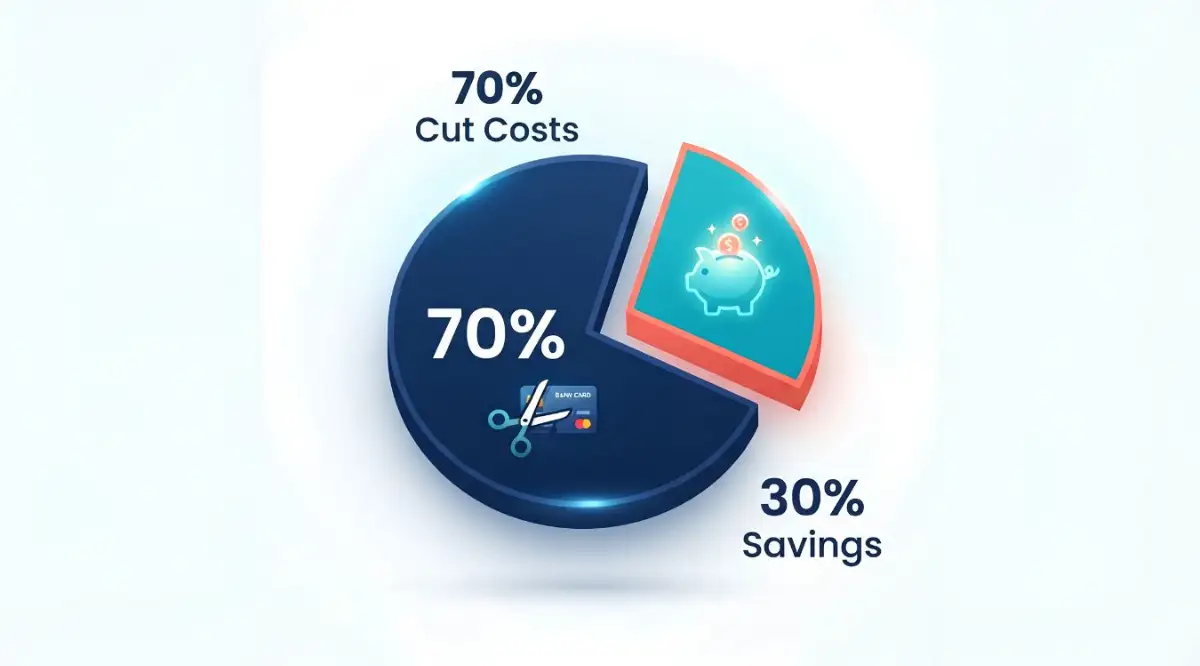
If you are dealing with aggressive, high-interest credit card debt, you need to lean heavily toward debt payoff. A highly effective split is the 70/30 rule.
When I first started splitting my money, I made the huge mistake of leaving my new emergency fund in my regular checking account, and I kept accidentally spending it on everyday things. I quickly realized that opening a completely separate savings account at a different bank was the only way to protect that cash from my own bad habits.
Take 70% of your disposable income and apply it as an extra payment toward your most dangerous high-interest debt. Take the remaining 30% and push it into your emergency savings account to slowly build it beyond your starter net.
Using our example of $500:
· $350 goes directly toward attacking the credit card principal.
· $150 goes directly into your High-Yield Savings Account.
Why the Split Strategy Works Psychologically
If you were to put all $500 toward the debt, you would definitely pay it off slightly faster. But human beings are not robots. We need to see positive progress to stay motivated over a long period.
By sending $150 to your savings every month, you get to watch your bank balance grow. Seeing that number rise gives you a tremendous sense of security and pride. It proves to your brain that you are capable of holding onto money.
At the same time, the $350 extra payment is aggressively eating away at the credit card balance. You are attacking the problem from both sides. You are walking and chewing gum at the same time, ensuring that your financial foundation is growing stronger every single day.
Phase 4: Scaling Up to a Fully Funded Emergency Reserve
Your starter safety net of $1,000 was just the beginning. It protects you from blown tires and small medical bills. But what happens if you suddenly lose your job? Or if you face a major medical event that keeps you out of work for two months?
A thousand dollars will not cover your rent and groceries for eight weeks. You eventually need a fully funded emergency reserve.
Defining Your Target Number
Financial experts universally recommend saving enough money to cover three to six months of essential living expenses. Notice the word "essential."
This does not mean three to six months of your total income. It only means the bare minimum amount you need to keep a roof over your head, keep the lights on, and put basic food on the table.
If your essential expenses are $2,500 per month, your ultimate savings target should be between $7,500 and $15,000.
Knowing When to Shift Your Ratios
You do not need to rush this large savings goal immediately. The beauty of the Split-Funding Method is that it is flexible.
Once you finally completely pay off your toxic, high-interest credit cards, you will suddenly have a lot more disposable income. You will no longer be making those massive monthly payments to the bank.
When this happens, you simply flip the ratio. Instead of 70% going to debt, you now send 70% or even 100% of your extra money directly into your emergency fund until you hit that three-to-six-month target. You adapt the system as your life circumstances change.
Strategic Moves to Protect Your Cash and Erase Balances Faster
You already understand the basic math behind splitting your money. Now, we need to talk about how you can speed up this entire process without feeling completely burned out. Managing money is an endurance race, not a quick sprint.
The absolute most effective secret in personal finance is removing your own willpower from the equation. Human beings are naturally impulsive, and we often make emotional decisions when we feel stressed. If you wait until the end of the month to see what cash is left over, you will never save anything.
You must set up automatic transfers the exact same day your paycheck hits your bank account. By automating your savings and your debt payments, you treat your financial future like a non-negotiable monthly utility bill. You cannot spend money that you never even saw in your main checking account.
If you are dealing with multiple different accounts, you might feel a little lost keeping track of exact due dates. I highly recommend learning a simple system for organizing multiple debt payments without feeling overwhelmed. A visual calendar on your refrigerator can completely change how you manage your cash flow.
The "Windfall" Allocation Strategy
Throughout the year, you will likely receive unexpected chunks of money. This might be a tax refund from the government, a holiday bonus from your employer, or even cash gifts from relatives. Most people view this extra money as a free ticket to buy something fun.
If you want to escape the debt cycle quickly, you need to treat these windfalls differently. I use a method called the "Rule of Thirds" whenever extra money lands in my lap.
You take the unexpected cash and divide it into three equal parts. One part goes straight into your emergency savings account to build your protective shield. The second part gets thrown directly at your highest-interest credit card balance.
The final third is yours to spend on whatever you want, completely guilt-free. This specific method prevents you from feeling deprived while still making massive progress on your financial goals.
Lowering the Cost of Your Borrowed Money
Many people assume that the interest rate on their credit card is set in stone. That is simply not true. You have the power to negotiate with your lenders, especially if you have a history of making on-time minimum payments.
Pick up the phone, call the customer service number on the back of your credit card, and politely ask for a lower Annual Percentage Rate (APR). Tell the representative that you are considering transferring your balance to a competitor's card. Bank representatives have the authority to lower your interest rate just to keep you as a paying customer.
Even a small reduction from 24% down to 18% can save you hundreds of dollars in interest charges over a few months. That is extra money that can immediately go toward funding your safety net. If you are unsure how these hidden fees actually affect your long-term plan, you should spend some time finding the true cost of your next loan before making any major financial decisions.
For deeper insights into how savings buffers actively reduce household financial distress, the Consumer Financial Protection Bureau provides excellent research on building a reliable savings buffer. Educating yourself through trusted government resources helps you understand the psychology behind sudden economic shocks.
The Power of Micro-Budgeting
You do not need a complicated spreadsheet to track every single penny you spend. Instead, try micro-budgeting for specific categories that tend to drain your wallet.
For example, look at how much you spend on takeout food or digital subscriptions every week. Challenge yourself to cut just $20 from your weekend entertainment budget.
Take that exact $20 and manually transfer it to your savings account right from your smartphone. These tiny, frequent transfers trick your brain into enjoying the act of saving money. It releases a small hit of dopamine, turning financial responsibility into a highly rewarding game.

Silent Wealth Killers: Why Most Savings Plans Fall Apart
Building a safety net while fighting lenders is a delicate balancing act. It is incredibly easy to accidentally step on a landmine that ruins months of hard work. You need to recognize these common traps before they happen to you.
The most dangerous threat to your progress is something called "Lifestyle Creep". This happens when you finally pay off one of your smaller debts, like a medical bill or a store credit card. Suddenly, you have an extra $100 sitting in your budget every month.
Instead of redirecting that $100 toward your next biggest debt or your savings, you start buying more expensive groceries or upgrading your internet package. You instantly absorb that newly freed cash back into your daily lifestyle. If you do this, you will remain trapped in the debt cycle forever.
The "Fake Emergency" Trap
Another major hurdle is failing to define what an actual emergency is. When you finally see $1,000 sitting in your savings account, your brain will try to convince you to spend it. You will start justifying purchases that are not actually urgent.
Real-Life Scenario: Your car starts making a strange noise, and the mechanic says you need new brake pads to drive safely. That is a true, genuine emergency.
However, seeing a massive holiday sale on a new laptop that you really want is entirely different. A sale is never an emergency, no matter how good the discount looks.
Here is a quick checklist to ask yourself before touching your reserve funds:
· Does this expense directly threaten my health, my safety, or my ability to earn income?
· Did I know about this expense in advance, or was it completely unpredictable?
· Can I delay this purchase for 30 days without suffering any serious consequences?
If the expense does not pass these three questions, you cannot touch your emergency cash. Period. The Office of the Comptroller of the Currency offers great consumer protection advice on managing revolving credit risk, highlighting how impulsive spending often leads directly back to high-interest borrowing.
The All-or-Nothing Mindset
Many hardworking people completely abandon their savings plan because they feel their contributions are too small. They look at their budget and realize they can only afford to save $15 a week. Because $15 feels insignificant compared to a $10,000 credit card balance, they decide to just spend the money instead.
This mindset is incredibly destructive. Saving $15 a week adds up to $780 in a single year. That is enough money to replace a broken water heater or buy four brand new tires for your vehicle.
Progress is still progress, no matter how slow it feels in the moment. The habit of saving money is actually much more important than the exact dollar amount you are saving. You are training your brain to prioritize security over immediate gratification.
Keeping Your Safety Net Too Close
I mentioned this briefly before, but it requires a deeper explanation because it is a very common failure point. If you can see your emergency fund every time you log into your main banking app, you are in danger.
When your checking account runs low on a Thursday before payday, the temptation to simply click "transfer" is overwhelming. You will borrow money from yourself, promising to pay it back next week. But you almost never pay it back.
Your emergency fund must live at a completely separate banking institution. You want the transfer process to take at least 24 to 48 hours to clear. That slight delay forces you to pause and evaluate if you are facing a true crisis or just a temporary inconvenience.
Your Immediate Action Plan for the Next 48 Hours
Reading about personal finance is helpful, but taking actual physical steps is what changes your life. You now have a proven framework to build your protective shield while aggressively attacking your lenders.
You no longer have to choose between saving for tomorrow and paying for the mistakes of yesterday. You are fully capable of handling both simultaneously. The fear of unexpected expenses does not have to control your daily mood anymore.
To make sure you do not lose this momentum, I have created a small challenge for you. Do not wait for the perfect time to start, because the perfect time does not exist.
Your Weekend Checklist
Step 1: Spend 15 minutes today opening a high-yield savings account at a completely new bank. Look for one that charges zero monthly maintenance fees.
Step 2: Log into your employer's payroll system or your main checking account. Set up an automatic transfer of just $20 to your new savings account. Schedule it to happen the morning after your next payday.
Step 3: Take your most dangerous, highest-interest credit card out of your wallet. Remove the saved card numbers from your internet browser and your favorite shopping apps. Put the physical card in a drawer at home so you are forced to stop adding new debt to the pile.
You are taking back control of your financial destiny today. Every small transfer you make is a brick in the wall that protects your family from financial ruin. Keep your head down, stay disciplined with the split-funding method, and watch how quickly your stress begins to melt away.
Escaping the constant loop of borrowing money while finally building my safety net was hard work, but the incredible peace of mind I have today is worth every single sacrifice. I know exactly how overwhelming your financial mess feels right now, but if I can turn my empty bank account around, I promise you can do it too. Take that very first step today, move just twenty dollars into a new savings account, and watch how fast your confidence grows!
Disclaimer: The information provided in this article is for educational and informational purposes only and does not constitute professional financial advice. Always consult with a certified financial planner or advisor before making any major decisions regarding debt management, investments, or personal savings strategies. Your financial situation is entirely unique, and you should evaluate all risks before taking action.