The Frustrating Reality of Slow Charging: My Personal Wake-Up Call
Switching to an electric car was supposed to be a dream, but my first week felt more like a math test I was failing. I quickly realized that plugging into a standard wall outlet is like trying to fill a pool with a straw. If you want to stop stressing about your battery percentage every morning, you need a real home charging strategy that actually works for your life, not just your car.
I clearly remember staring at my car dashboard in total disbelief late one Wednesday evening. I had just driven home from a long family trip, and my electric vehicle battery was sitting at a terrifyingly low four percent. I confidently grabbed the standard charging cable that came with the car, plugged it into my regular garage wall outlet, and looked at the screen to check the estimated completion time. The display calmly informed me that it would take more than two full days to reach a complete charge.
My heart instantly sank because I had an important morning meeting the very next day. I needed at least a sixty percent charge just to make the round trip comfortably. I spent the entire night tossing and turning, calculating miles in my head, and wondering if I would end up stranded on the side of the highway. That specific moment of pure range anxiety made me realize something very important. Relying on a standard wall plug for daily driving is not just inconvenient, but it actively destroys your peace of mind.
Most new electric car owners experience this exact same horrifying realization during their first few weeks of ownership. You transition to an electric vehicle expecting freedom from gas stations, only to find yourself chained to a slow trickle of electricity at home. You start waking up extremely early just to check if the battery gained enough range overnight. Your daily schedule slowly becomes dictated by your charging speed, which completely ruins the joy of driving your new car.
Quick Guide: How to Win at Home Charging
Before we dive into the wires and volts, here is the 'too long; didn't read' version of what you need to know:
- Upgrade to Level 2: A 240V outlet is the only way to avoid 'range anxiety' and get a full charge overnight.
- The 80% Safety Rule: Never max out your circuit; if you have a 50-amp breaker, only pull 40 amps to prevent fires.
- Hardwiring is Better: For the fastest and safest connection, skip the plug and have your electrician wire the unit directly.
- Get a Permit: Don't cut corners. A legal permit protects your home insurance and your family's safety."
Decoding the Electrical Mystery Without Getting Shocked
Before you even think about touching a wire or calling a professional, we need to talk about what makes home charging actually work. Many people feel extremely intimidated by electrical terms like volts and amps. We often assume that dealing with home electricity requires an advanced engineering degree.
However, understanding the basic science behind your charging station is highly necessary for your safety. I like to think of electricity exactly like a plumbing system in a house. The voltage is simply the water pressure pushing through the pipes, while the amperage is the actual size of the pipe itself.
A standard wall outlet in your home is only 120 volts, which is like trying to fill a massive swimming pool using a tiny garden hose. It works, but it takes an incredibly long time to see any real progress. A Level 2 charging station runs on 240 volts, which is exactly the same amount of pressure used by heavy appliances like your electric dryer or your kitchen oven. This upgrade essentially replaces that tiny garden hose with a massive fire hose, allowing electricity to flow into your car much faster.
Quick Myth Buster: Does Fast Charging Kill Your Battery?
You might have heard that Level 2 charging is 'too fast' and will hurt your battery life. The Fact: Modern EVs are designed to handle 240V power easily. In fact, Level 2 charging is often better for your car's health because it allows the battery's cooling system to run more efficiently while charging compared to a slow trickle.
The Real Difference Between Level 1 and Level 2 Performance
To truly understand why you need to upgrade, we have to look closely at the realistic performance numbers. A standard Level 1 charger will generally give you about three to five miles of range for every hour it stays plugged in. If you sleep for exactly eight hours, you only gain around forty miles of driving range.
If your daily commute is longer than forty miles, you will slowly lose battery percentage every single day of the week. By the time Friday arrives, your battery will be almost completely empty. A Level 2 charger completely eliminates this mathematical nightmare.
To help you visualize the difference, here is a quick breakdown of what you can expect from each setup:
Depending on the specific hardware you choose, a 240-volt setup can deliver anywhere from twelve to forty miles of range per hour of charging. This means a completely empty battery can easily reach a full state of charge while you sleep peacefully through the night. You wake up every single morning with a full tank of electricity, ready to tackle whatever the day brings.
Assessing Your Home's Electrical Panel Capacity
Your very first practical step is to locate and inspect your main home electrical panel. This is usually a grey metal box located in your garage, basement, or sometimes on the side of your house. You need to open the door and look for the main breaker switch sitting at the very top or bottom of the panel.
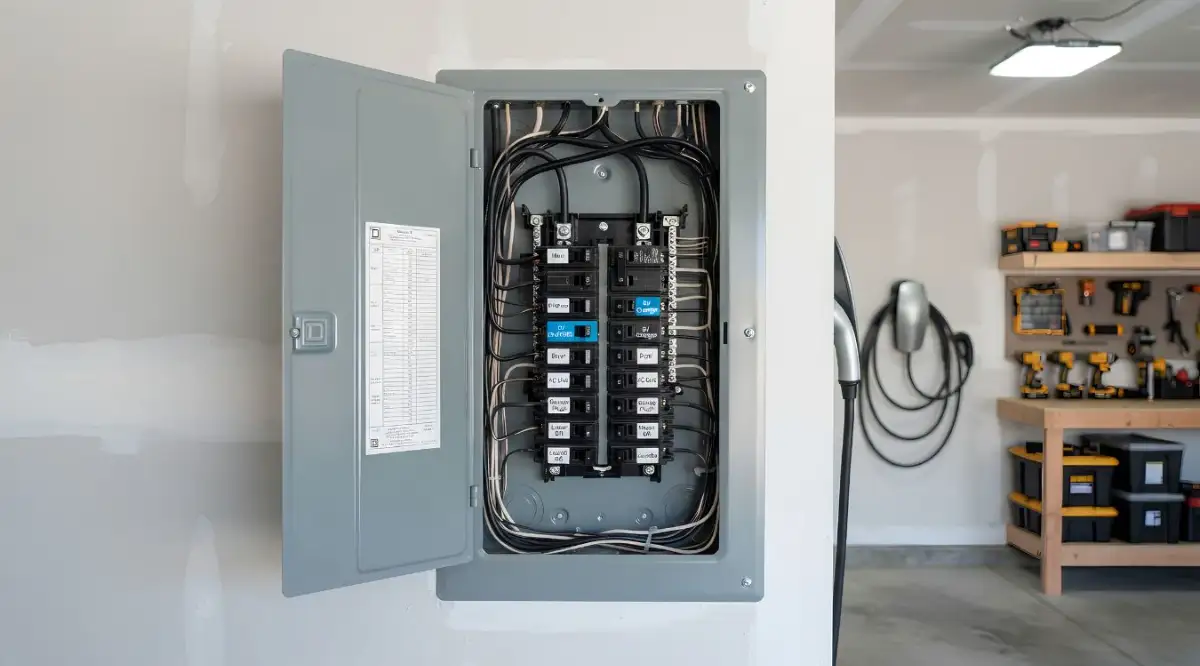
This main switch will have a number printed on it, usually ranging from 100 to 200. This number represents the total amperage your local utility company supplies to your entire house. If your home only has a 100-amp service, adding a heavy 50-amp charging station might overload your system when you run the air conditioning at the same time.
I actually made a pretty embarrassing mistake when I first looked at my electrical panel. I assumed that because I had empty slots for new breakers, I had plenty of available power to use. My electrician quickly pointed out that the physical space in the box does not equal the actual power capacity coming from the street. Always remember that available slots do not automatically guarantee available amperage!
The Golden Safety Rule of Continuous Load
When dealing with electric vehicle charging, we have to respect a fundamental safety concept known as the continuous load rule. Most regular appliances in your home turn on and off in short bursts. Your microwave runs for two minutes, and your refrigerator compressor cycles on for maybe twenty minutes at a time.
Charging a car is completely different because it pulls a massive amount of power continuously for several hours straight. Because of this intense and constant demand, electrical safety standards mandate that a circuit should only handle 80 percent of its maximum capacity. If you install a 50-amp circuit breaker, your charging station should legally and safely only pull 40 amps of power.
Pushing a circuit to its absolute maximum limit for hours will generate extreme heat inside your walls. This heat can slowly melt the insulation around the wires over time, creating a severe fire hazard while you sleep. Understanding this eighty percent rule will protect your home and your family from easily avoidable disasters.
Choosing the Perfect Location for Your Equipment
Once you understand the electrical capacity of your home, you have to decide exactly where to mount the charging unit. Your first instinct might be to place it right next to your electrical panel to save money on wiring. While keeping the wire run short does save money, it might not be the most practical location for your daily routine.
You need to think deeply about how you actually park your car every single day. Look closely at where the charging port is located on your specific vehicle model. Some cars have the port on the front grille, while others have it on the rear driver side.
You absolutely do not want a heavy, thick cable stretching tightly across your garage floor where people might trip over it. If you plan to install the station outside in your driveway, you must ensure the hardware is completely weather-rated for rain and snow. Always measure the distance from the proposed mounting spot to your car's charge port, and then add at least five feet of extra slack for safety.
I completely messed this up at my own house by installing the charging box right next to the door just because it looked nice there. Every single day, I had to awkwardly drag a heavy, dirty cord across the hood of my wife's car just to reach my charging port. Take my advice and actually park your car in the garage first, then mock up the exact cord path with a piece of string before you let anyone drill a single hole!
Myth vs Reality: Plug-In Models versus Hardwired Installations
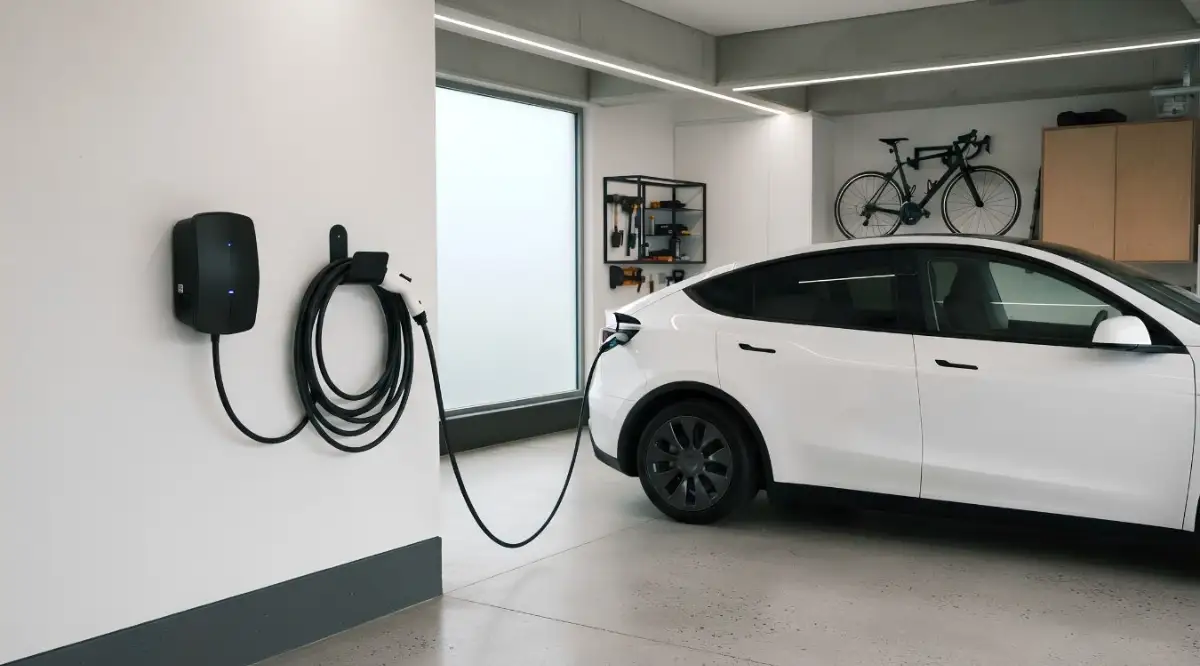
When you start shopping for equipment, you will quickly notice two distinct installation options available. You can either buy a unit that plugs directly into a heavy-duty wall outlet, or you can buy a unit that gets permanently hardwired into the wall. A massive myth in the electric car community is that plug-in models are always better because you can easily take them with you if you move.
The reality is that hardwiring your station is significantly safer and often much more reliable in the long run. Plug-in models require a specialized 240-volt receptacle, like a NEMA 14-50 outlet, which adds an extra connection point that can potentially overheat. Many standard outlets sold at hardware stores are not designed for the continuous, heavy load of an electric vehicle.
Hardwiring completely removes the outlet from the equation, running the power directly from your breaker box straight into the charging unit. This direct connection drastically reduces the risk of overheating and usually allows you to charge at slightly faster speeds. If you want maximum safety and maximum charging speed, hardwiring is almost always the smarter choice.
The Hidden Impact on Your Battery's Lifespan
Many people completely ignore the relationship between home charging speeds and long-term battery health. You might think that slow Level 1 charging is actually gentler and better for the battery cells. Interestingly, the exact opposite is often true when it comes to extreme weather conditions.
Electric vehicle batteries have built-in thermal management systems that work hard to keep the cells at a comfortable temperature. During freezing winter nights or boiling summer days, the car needs to warm up or cool down the battery pack. If you are plugged into a slow 120-volt outlet, the car often uses more energy to heat the battery than it actually receives from the wall.
A Level 2 charging station provides enough raw power to easily run the thermal management system while simultaneously pushing energy into the battery. This means the car does not have to drain its own reserves to keep the cells safe from the weather. Properly conditioning your battery using grid power is a fantastic way to protect the long-term health of your vehicle.
Navigating Permits and Professional Help
We have finally reached the most important safety advice in this entire educational guide. Installing a 240-volt circuit is absolutely not a weekend project for a casual hobbyist. Even if you have successfully changed a light switch or installed a ceiling fan in the past, a high-voltage charging station is a completely different beast.
You must hire a licensed, certified electrician who has specific experience with electric vehicle equipment. A professional will handle all the complex load calculations and ensure the correct wire gauge is safely routed through your walls. Furthermore, nearly every local municipality legally requires a permit and a formal inspection for this type of major electrical work.
Skipping the permit process might seem like a clever way to save a little bit of time and money right now. However, if an unpermitted electrical fire damages your home, your insurance company can easily deny your entire claim. Taking the time to do things exactly by the book protects your massive financial investment and guarantees your family sleeps safely every single night.
Mastering Your Home Charging Routine Like a Pro
Now that we have covered the basic foundation of electrical capacity, it is time to look at how you can make your daily routine incredibly efficient. Getting the hardware on the wall is only half the battle when it comes to EV ownership. You want to set up a system that runs automatically, saves you money, and requires zero daily effort.
One of the smartest moves you can make is taking full advantage of Time-of-Use utility rates. Many electricity providers offer massive discounts if you pull power during off-peak hours, typically in the middle of the night. By setting your car to only accept power after midnight, you can slash your monthly driving costs significantly. You can read more about how utility rate structures impact savings directly from the U.S. Department of Energy guidelines on utility rates.
This is where investing in a Wi-Fi-enabled smart station becomes an absolute game changer for your wallet. A smart unit connects directly to your home network and allows you to track exactly how much energy you use every single month. You can easily program your charging schedules straight from a mobile app while sitting comfortably on your couch.
If you just buy a basic, non-connected unit, you will have to rely entirely on your car's internal software to manage schedules. While most modern electric cars have scheduling software built into the dashboard, it is often clunky and difficult to navigate. Having a dedicated smart app for your wall unit gives you much better control and detailed reporting.
The Secret of Load Management Devices
Many older homes simply do not have enough overall electrical capacity to support an extra 50-amp circuit. Upgrading your entire main breaker panel to a 200-amp service can easily cost several thousand dollars. Thankfully, technology has given us a brilliant workaround known as a smart load management device.
These small, intelligent devices are installed directly inside your electrical panel alongside your new circuit. They constantly monitor exactly how much power your entire house is using at any given second. If you turn on your electric oven, your heavy clothes dryer, and your air conditioning all at once, the system notices the spike in demand.
To prevent your main breaker from tripping, the load manager will automatically pause the power going to your car. Once you finish cooking and turn off the oven, the system sees the available capacity and resumes feeding electricity to your vehicle. This amazing technology allows you to safely install high-powered equipment in older homes without paying for massive electrical upgrades.
Curious about how a load management device actually prevents your main breaker from tripping while charging your car? Watch this quick video below to see exactly how this smart little gadget balances your home's electricity, and then keep reading to learn how to avoid the most dangerous electrical traps!
Protecting Your Financial Peace of Mind
Doing things right the first time might seem expensive, but cutting corners with high voltage can lead to absolute disaster. An unexpected electrical fire from a faulty DIY setup can easily cause severe property damage and drain your savings. This is exactly why learning the secret to building an emergency fund without ignoring your debt is so important for homeowners.
You never want to find yourself in a situation where you are forced to pay out of pocket for major home repairs. Proper planning and professional installation serve as an insurance policy for your peace of mind. Spending a little extra on a certified electrician today will protect your biggest asset tomorrow.
The Hidden Dangers of Rushing Your Electrical Setup
When people finally buy their dream electric car, they usually want to get their garage set up as fast as humanly possible. This exact sense of urgency leads many new owners straight into dangerous and expensive traps. Let us look closely at the most common disasters people face so you can easily avoid them.
The most terrifying mistake I see regularly is buying uncertified, cheap charging equipment from random overseas websites. You might see a wall unit online that costs half the price of a reputable brand and think you found a great deal. However, these cheap units completely skip rigorous safety testing and often lack basic thermal protection sensors inside the handle.
If a cheap charging handle gets too hot during a long overnight session, it will literally melt into your car's expensive charging port. This will completely destroy your vehicle's onboard electronics and likely void your manufacturer warranty instantly. Always look for equipment that has been officially certified by a recognized testing laboratory, which you can verify through standards set by UL Solutions for EV safety.
The Grandfather's Wiring Assumption
Another massive pitfall is assuming that the existing heavy-duty outlet in your garage is perfectly safe to use for your car. You might have an old 240-volt outlet that your grandfather previously used for a large air compressor or a welding machine. People often just plug their new thousand-dollar charging cable directly into this dusty, thirty-year-old receptacle.
What they fail to realize is that a welding machine only runs for short, intermittent bursts of power. An electric vehicle pulls maximum, continuous power for eight to ten hours straight, which creates an extreme amount of heat. Old, worn-out outlets have loose internal contacts that cause heavy electrical resistance, eventually leading to sparks and smoke.
If a dangerous electrical setup causes a fire and someone gets hurt, you will suddenly find yourself dealing with medical emergencies. Understanding how to handle unexpected costs is tough, much like understanding health deductibles and co-pays when navigating the medical system. Simply replacing an old receptacle with a commercial-grade, heavy-duty version only costs a few dollars but saves lives.
Ignoring Proper Cable Management
It sounds extremely basic, but terrible cable management ruins more charging equipment than actual electrical failures. People often leave their thick, heavy cables lying flat on the concrete garage floor in a tangled mess. When you are rushing to leave for work in the morning, it is incredibly easy to accidentally run over the handle with your tires.
Crushing the handle under a heavy car instantly shatters the delicate communication pins located inside the connector. Once those small pins are bent or broken, the station can no longer talk to the car, rendering the entire unit useless. You will have to replace the entire heavy cable assembly, which often costs nearly as much as buying a brand new station.
Always mount a proper cable organizer or a simple garden hose hook right next to your station. Make it a strict daily habit to loop the cord neatly and holster the handle immediately after you unplug your car. Taking ten seconds to hang up your cord will easily add years to the lifespan of your expensive equipment.
Failing to Consider Weather Extremes
If you do not have a garage, you will obviously have to mount your station completely outdoors in your driveway. Many people make the massive error of installing indoor-rated units directly on the side of their house, fully exposed to the elements. Rain, snow, and extreme summer humidity will quickly corrode the internal circuit boards of an indoor unit.
You must specifically look for a unit that carries a proper NEMA 4 or NEMA 4X weather rating. These specific ratings guarantee that the outer casing is completely sealed against blowing rain, ice formation, and fine dust. The National Fire Protection Association provides excellent safety guidelines regarding outdoor electrical installations, which you can read at the NFPA electrical safety hub.
Even if you buy a fully weather-rated unit, try to avoid installing it directly in the blazing afternoon sun. Extreme external heat combined with the internal heat of charging can cause the unit to automatically slow down the charging speed to protect itself. Finding a shaded spot on the side of your house will keep your equipment running at maximum speed all summer long.
Skipping the Official Permit Process
We touched on this earlier, but ignoring local building permits is a trap that catches many well-meaning homeowners. You might hire a friend who knows a little bit about electrical work to wire things up on a Saturday afternoon. While it might work perfectly fine for months, this undocumented work becomes a massive legal headache later on.
When you eventually decide to sell your house, a thorough home inspector will immediately flag the unpermitted high-voltage circuit. You will then be forced to hire a professional to completely tear it out and redo it legally before the sale can close. Keeping proper records of your permitted electrical work is just as necessary as documenting workplace discrimination before seeking legal help if you want to protect yourself legally.
Do not let impatience force you into making decisions that put your property at unnecessary risk. A licensed professional will handle the permit, pass the local city inspection, and give you official paperwork proving the setup is safe. This simple piece of paper adds actual value to your home and keeps your insurance policy fully intact.
Your Action Plan for Stress-Free Electric Driving
Transitioning away from gas stations completely transforms how you interact with your vehicle on a daily basis. By taking the time to understand your home's electrical capacity, you take total control over your daily driving routine. You are no longer bound by public charging stations or the painfully slow drip of a standard wall outlet.
The journey from extreme range anxiety to waking up with a full battery every morning is truly liberating. Every single step we discussed today is designed to build a safe, efficient, and highly reliable system for your home. You can now confidently talk to an electrician, ask the right questions, and choose the perfect hardware for your specific needs.
I remember the exact morning I woke up and saw my car fully charged by my newly installed station for the first time. My entire perspective on driving shifted instantly, and the daily worry completely vanished from my mind. I know that if you follow these simple educational steps, you will experience that exact same incredible feeling very soon.
Common Questions About Setting Up Your Home Station
Do I absolutely need to buy a smart station with Wi-Fi?
You do not strictly need a smart station to charge your car effectively at home. A basic "dumb" charger works perfectly fine and simply pushes power whenever it is plugged into the vehicle. However, a smart station easily pays for itself by helping you track energy usage and easily schedule charging during cheaper off-peak hours.
Can I safely leave my car plugged in for several days?
Yes, it is highly recommended to leave your vehicle plugged in if you are going away for a few days. Modern electric vehicles have highly intelligent battery management systems that automatically stop the flow of electricity once the battery reaches your set limit. Leaving it connected allows the car to use wall power to keep the battery warm or cool, protecting the internal cells.
Will installing a charger make my electric bill skyrocket?
Your total electricity bill will naturally go up because you are consuming more home energy instead of buying gasoline. However, the cost of electricity per mile is significantly lower than the cost of liquid fuel. By using scheduled nighttime charging, most owners actually save a substantial amount of money compared to their old gas-powered commutes.
How long does a quality wall unit typically last?
A high-quality, properly installed charging unit from a reputable brand will easily last for eight to ten years with zero issues. Since there are no moving parts inside the main box, the only thing that usually wears out is the physical charging cable. Taking good care of the handle and keeping the cable neatly coiled will drastically extend the life of your equipment.
Do I need to upgrade my panel if I only drive short distances?
If you only drive ten to fifteen miles a day, you might not need a massive 50-amp electrical setup. You can ask your electrician to install a smaller 20-amp Level 2 circuit, which uses much less overall panel capacity. This smaller setup will still easily replace your daily mileage overnight without requiring an expensive total panel upgrade.
Upgrading your home electrical setup is the absolute best investment you can ever make for your daily driving happiness. Call a few local electricians this week to get some free quotes, and take that first step toward real freedom. You deserve to wake up every single morning with a fully charged car and absolutely zero stress!
Disclaimer: The information provided in this article is for educational and informational purposes only and does not constitute professional electrical or legal advice. Electrical work can be highly dangerous and potentially fatal. Always consult with a licensed, certified electrician and obtain the necessary local permits before making any modifications to your home’s electrical system. The author and publisher are not responsible for any damage, injury, or loss resulting from the use of this information.